
When did Fashion “Become” Political?
Recently, I read an article in Les Echos titled “Tongs Havaïanas, Florsheim ou baskets… Quand les chaussures deviennent des symboles politiques” (“Havaianas flip-flops, Florsheim shoes or sneakers… When shoes become political symbols”). The piece explores different aspects of political fashion, from the backlash surrounding a campaign for Havaianas in Brazil to Donald Trump reportedly imposing leather Oxfords on members of his entourage, before tracing the long political life of fashion through punks in Dr Martens, bourgeois distinction, and the symbolic circulation of sneakers.

At first, I found it slightly amusing that the politicisation of shoes could still be framed as a form of contemporary curiosity. Fashion has always been political. Yet as I kept reading, what interested me was not the fact that clothing carries ideology, but the way certain aesthetics continue to escape that reading altogether.
Because perhaps fashion only appears political when it visibly deviates from dominant aesthetics.
A flip-flop can become “left-wing.” A pair of boots can become associated with protest movements, nationalism, or subculture. Yet the Oxford shoe, the restrained silhouette, the muted palette of institutional elegance rarely attract the same kind of scrutiny. They are still presented as neutral, professional, and universal. Their political dimension dissolves into familiarity.

Photo : Communiqué de presse/Havaianas
If certain garments immediately attract interpretation, others seem to escape it altogether. Some aesthetics become so embedded within institutions, public life, and everyday visual culture that they stop appearing culturally specific at all, and their meanings dissolve into habit. The polished leather shoe, the restrained silhouette, the muted palette associated with professionalism rarely provoke commentary, or at least negative commentary. They move almost unnoticed through spaces of power and public life. Over time, certain silhouettes, materials, and forms of presentation become so familiar that they no longer feel aesthetic at all. They begin to register instead as common sense: serious, respectable, appropriate.
The power of fashion often resides in its discretion. The more deeply an aesthetic embeds itself within everyday life, the less ideological it appears. As Roland Barthes observed in The Fashion System, clothing never simply covers the body; it produces meaning. Yet some meanings become so normalized that they disappear into the background of social life. The same can be said of taste itself. In Distinction, Pierre Bourdieu argued that what societies perceive as elegant, respectable, or refined is never entirely spontaneous or individual. Taste is shaped socially long before it feels personal. No aesthetic is naturally more legitimate; certain aesthetics become associated with authority because institutions repeatedly frame them as such.
And perhaps this is why fashion is so often described as political only when its codes become too visible, too excessive, or too unfamiliar. Certain aesthetics remain highly legible as cultural statements, while others dissolve more easily into the background of social life. Some forms of dress continue to appear marked, coded, or culturally specific, while others have gradually come to present themselves as universal. Yet there is nothing natural about that universality.
The impression that certain aesthetics are simply neutral or professional stems from many factors. Colonialism is one of them. It played a significant role in tying European forms of appearance to ideas of civilisation, education, and legitimacy. Across colonial administrations, missionary schools, and urban elites, dress became a way of signalling proximity to power.
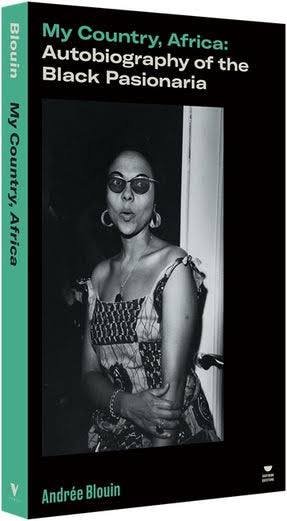
In many colonial contexts, respectability had to be made visible. Across administrations, missionary schools, and colonial elites, legitimacy often became tied to one’s ability to navigate European social and aesthetic codes. In colonised Africa, figures such as the évolué* embodied this logic particularly clearly: education, etiquette, bodily discipline, and appearance became intertwined with the performance of assimilation itself. My Country, Africa shows how these hierarchies could penetrate everyday life through seemingly ordinary details. In the orphanage where she grew up, the girls were generally kept barefoot “to avoid the sin of pride,” yet Blouin was exceptionally given shoes when her white father came to visit. She also recalls being mocked for sitting “like a European lady,” marking how posture, presentation, and self-regard could become suspect. In these moments, appearance becomes tied not simply to clothing itself, but to broader systems of discipline, hierarchy, and social legitimacy within colonial society.
Many of these visual hierarchies persist long after the formal end of colonial rule. Certain aesthetics continue to move through institutions without attracting attention to themselves, while others remain immediately read as ethnic, political, religious, or cultural. The keffiyeh, natural hair, visible religious garments, queer aesthetics, or certain forms of streetwear are often interpreted before the people wearing them even speak. Meanwhile, other aesthetics continue to benefit from the privilege of familiarity.
Perhaps this is why controversies like the Havaianas debate continue to resurface: fashion has always participated in shaping political worlds, silently distributing legitimacy, visibility, seriousness, and belonging. Some aesthetics simply became so dominant that we stopped seeing them as aesthetics at all.
And maybe the most political forms of dress are precisely the ones we no longer notice.