
Staging a Life Under Pressure: Charlotte Salomon
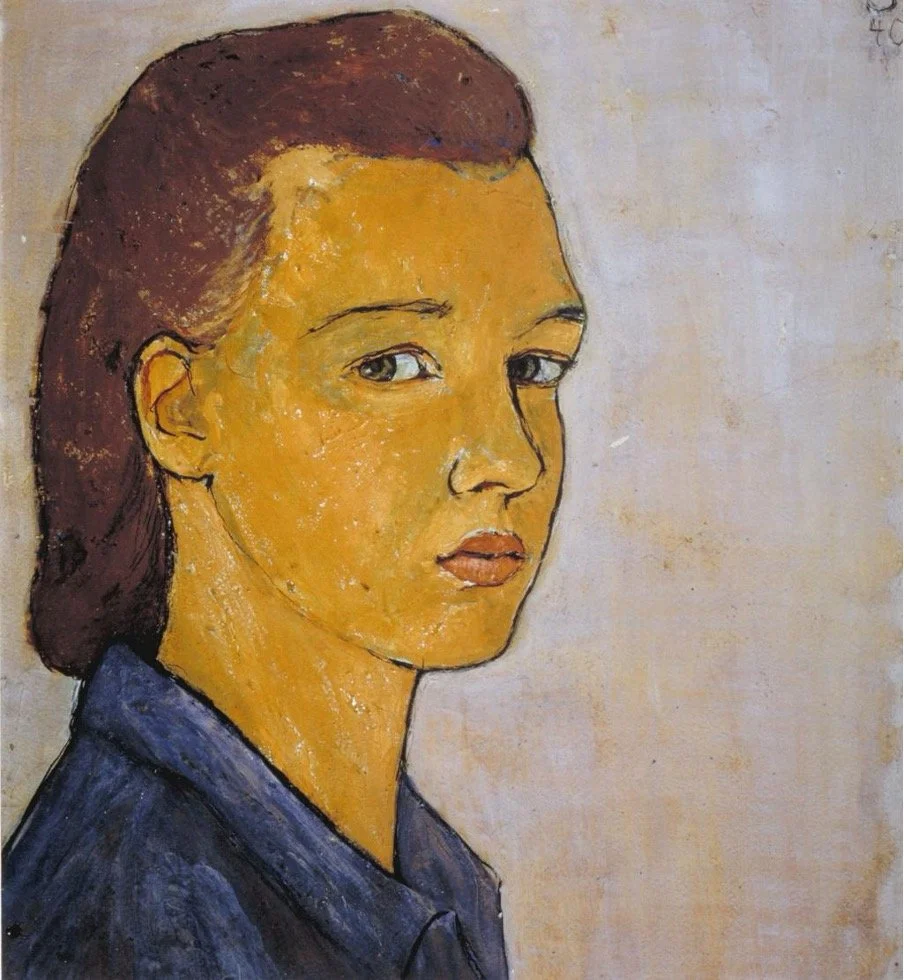
In the early 1940s, in exile in the South of France, Charlotte Salomon began producing work at a pace that resists ordinary explanation. Between 1940 and 1942, she created hundreds of painted sequences that would later form Life? or Theatre?. The scale alone suggests urgency. But urgency does not fully account for what emerges: not a record of a life, but its deliberate construction under pressure.
To begin with, urgency is not simply a rhetorical choice. It reflects the conditions under which the work becomes possible. Salomon’s exile to the South of France in 1939, the suicide of her grandmother in 1940, and the subsequent revelation of a family history marked by repeated suicides form a sequence of shocks that compress time into something immediate and unstable [1]. Her internment
at the Camp of Gurs further intensifies this sense of suspension, placing her within a broader historical collapse [2]. In this context, painting does not appear as a reflection or recollection. It emerges instead as a necessity, an answer to a situation in which both psychological continuity and historical stability have become untenable [3].
Yet nothing in Life? or Theatre? resembles an unmediated act of remembering. The work does not unfold as a diary, nor does it present itself as a linear testimony. Salomon renames herself “Charlotte Kann,” distributes roles, and constructs scenes. Text is first written on transparent overlays before being integrated into the painted surface, while musical references to Mozart, Schubert, and Bizet are woven into the sequences, suggesting rhythm as much as narration [4]. The work is explicitly conceived as a Singespiel, a composite form combining image, text, and music [5]. What is at stake, then, is not the preservation of memory in its raw state, but its reorganisation.
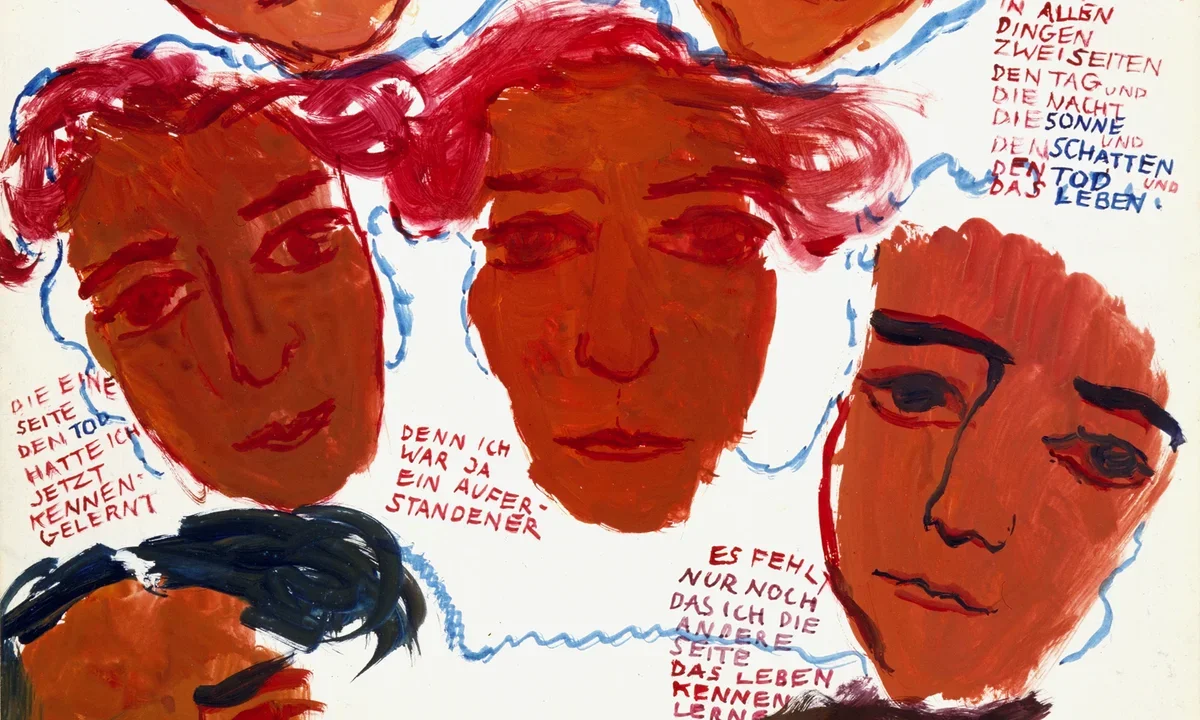
Graphic autobiography — from Charlotte Salomon’s Leben? oder Theater? Ein Singspiel, 1941–42. Click here to see the full image Photograph: Charlotte Salomon Foundation
This distinction is crucial. If memory were sufficient, it could remain fragmentary, partial, unresolved. But here, memory is subjected to a process of construction. Experience is redistributed into scenes, voices, and temporal layers. Beyond recounting her life, her work stages it. In doing so, Salomon occupies a position that is at once unstable and controlled: she is simultaneously the subject of the narrative, its narrator, and its director.
At this point, a parallel with Gillian Rose's thought becomes instructive. In works such as Love’s Work, Rose challenges the tendency to transform suffering into a coherent narrative. For her, the ethical problem lies precisely in the impulse to resolve contradiction, to produce clarity where experience remains fractured. Rather than smoothing over tension, she argues for remaining within it.

Read in this light, Salomon’s work appears not as an attempt to stabilise experience, but rather as a refusal to do so. The multiplication of voices, the fragmentation of scenes, and the coexistence of different temporalities prevent the work from settling into a single, unified account. The past is re-enacted alongside a present marked by threat and a future that may not arrive. The result is not coherence, but a form of controlled instability.
This instability is not accidental. It is produced by the conditions under which the work is made. As time contracts, the form itself becomes denser. Text begins to occupy more space, sometimes layered over the image, sometimes absorbed into it, eventually saturating the visual field [6]. Sequences accelerate, becoming more schematic, more compressed, as if shaped by the pressure of completion [7]. The work employs procedures resembling cinematic montage, close-ups, repetition, and shifts in perspective, producing a form of simultaneity rather than linear progression [8].
In this sense, staging is not an aesthetic embellishment. It is a response to urgency. When time no longer allows for the slow sedimentation of memory, experience must be reorganised in order to persist. The theatrical and musical elements of Life? or Theatre? do not distance the work from reality; they provide the structure through which reality can be held together, however provisionally.
What emerges, then, is a constructed field of tensions. The work does not offer closure, nor does it attempt to produce a definitive account of a life. Instead, it maintains the contradictions that define its conditions of production: between past and present, between lived experience and its representation, between the desire to preserve and the impossibility of doing so completely
Before her deportation to Auschwitz in 1943, Salomon entrusted her work to a friend, reportedly describing it as her entire life [9]. The gesture suggests an awareness of its function, not as a testimony in the conventional sense, but as something more deliberately constructed. What is preserved is not life as it was lived, but life as it has been staged, organised, and made transmissible.
To read Life? or Theatre? as a simple act of remembrance is therefore to miss its central operation. Under the pressure of a collapsing historical moment, Salomon leaves no coherent narrative of her life. She constructs a form that resists coherence altogether, one that holds experience in tension rather than resolving it, and in doing so, refuses the consolations of narrative closure.
-
[1] Jewish Cultural Quarter; “Meet Charlotte Salomon”
[2] Jewish Museum Berlin, “Afterword”
[3] AWARE, “The Game of Life”
[4] Jewish Cultural Quarter, “About the Work”; “Music in Charlotte Salomon’s Work”
[5] Jewish Museum Berlin, “Prelude”
[6] AWARE; Jewish Museum Berlin
[7] Jewish Cultural Quarter
[8] Bernard-Nouraud, OpenEdition
[9] Jewish Cultural Quarter